Water Climate Adaptation Finance Demands Blended Capital to Bridge Escalating African Deficit
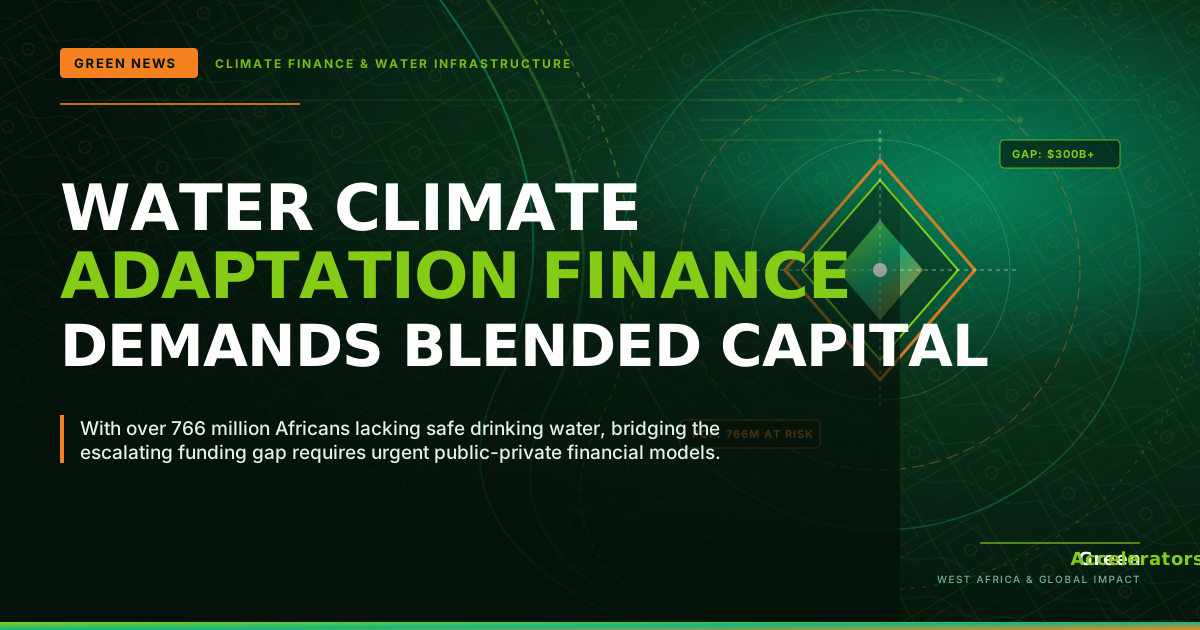
With over 766 million Africans lacking safe drinking water despite historical development assistance, national policy makers and climate funds must pivot toward blended finance, commercial irrigation technology, and decentralized water infr
The Shrinking Capital and Expanding Deficit in African Water
Africa faces a compounding systemic crisis where climate impacts directly undermine hydrological stability, while international aid capital for water resilience contracts. Recent multi-lateral assessments reveal that more than 500 million people across one-third of African nations live under conditions of severe water insecurity.
Between 2015 and 2021, the absolute number of people across the continent without access to safely managed drinking water rose from 703 million to 766 million. This worsening deficit occurred even as Africa absorbed roughly one-third of all global official development assistance targeted at the water sector. Concurrently, global official development assistance disbursements for water infrastructure dropped 15 percent, falling from $9.6 billion to $8.1 billion.
The physical reality of climate change compounds this financing contraction. Four out of five primary physical markers of global climate disruption, shifting precipitation patterns, extreme weather surges, melting glaciers, and rising sea levels, manifest directly through hydrological disruption. Traditional donor funding mechanisms have proven structurally inadequate to keep pace with these escalating environmental pressures.
Why Aid Alone Fails Water Infrastructure Investment
The traditional reliance on official development assistance has created a fragile operational landscape across sub-Saharan Africa. Conventional grant funding prioritizes initial capital expenditure for civil works while routinely ignoring long-term maintenance logistics, grid reliability, and operational cost recovery. When grant cycles expire, physical assets deteriorate rapidly, returning vulnerable populations to water insecurity.
Transitioning from grant reliance to sustainable water security requires structured water infrastructure investment backed by commercial and semi-commercial capital. Private investors require bankable risk-return profiles, transparent tariff regulation, and robust institutional governance before committing long-term capital to water assets.
Unlocking non-grant capital demands green finance mechanisms such as first-loss guarantees, partial credit risk coverage, and targeted subsidies for lower-income consumers. When water utilities incorporate energy-efficient distribution systems, industrial wastewater treatment, and automated metering, water operations convert from passive cost centers into resilient, revenue-generating climate adaptation assets.
What This Means for Nigeria
For Nigerian green economy practitioners, solar engineers, municipal authorities, and agricultural entrepreneurs, the shift toward commercial climate adaptation finance creates immediate operational and commercial mandates. Nigeria's agricultural heartlands and expanding urban centers face severe water stress, yet public water boards operate far below installed capacity due to inadequate municipal budgets and erratic grid power.
In my work directing climate adaptation initiatives across Akwa Ibom State, particularly within oil-host communities along the coastal belt of Ibeno and Mbo, I have seen donor-funded water schemes collapse repeatedly. Shallow groundwater sources face continuous saltwater intrusion caused by sea level rise and coastal erosion. When international development grants built solar-powered boreholes without integrating community-managed revenue models, commercial maintenance agreements, or high-grade filtration technology, those systems routinely failed within eighteen months.
To prevent these failures, Nigerian green actors must focus on three commercial vectors:
First, agricultural developers and youth-led enterprises must scale commercial solar-powered drip irrigation. Converting smallholder farmers from rain-fed agriculture to precise, low-emissions irrigation creates predictable crop yields and generates verifiable climate adaptation metrics required by international blended finance facilities.
Second, municipal water agencies and state governments must institute clear regulatory frameworks for private water concessions. Allowing independent water producers to deploy solar pumping, desalination, and advanced purification under public-private partnerships will attract institutional water infrastructure investment that public budgets currently cannot provide.
Third, local non-governmental organizations and grant writers must pivot from soliciting standalone water grants to structuring joint ventures with green technology vendors. Grant capital should serve strictly as catalytic de-risking funds that mobilize local commercial bank lending for climate-resilient water assets.
What to Watch
Practitioners across West Africa should track three pivotal indicators over the coming quarter:
- At 30 Days: The rollout of updated project selection criteria from regional development finance institutions, prioritizing water recycling, governance reform, and energy efficiency within climate adaptation portfolios.
- At 60 Days: The release of state-level public-private partnership guidelines in Nigeria designed to de-risk private investment in decentralized rural and peri-urban water utilities.
- At 90 Days: The launching of dedicated climate-smart agriculture credit lines by domestic commercial banks targeting solar irrigation equipment for commercial farmers and cooperative clusters.
For practitioners in Nigeria and across Africa, this signals an urgent imperative to abandon grant-dependent project models and build commercially viable, technology-driven water adaptation enterprises capable of attracting institutional capital.
Related Green Opportunities
Found this useful? Share it →
Written by Elkanah Oluyori
Executive Director, Clement Isong Foundation · Uyo, Akwa Ibom State, Nigeria
Elkanah leads Clement Isong Foundation with 16+ years of experience in green economy development, climate justice, and civic technology in Akwa Ibom State and Nigeria. He is the founder of GreenAccelerators, Nigeria's first green economy opportunity portal.
Read all articles by Elkanah Oluyori →Get Weekly Green Opportunities in Your Inbox
Every Monday, we send the best verified green jobs, grants, fellowships and training opportunities — from Nigeria to the world, deadline still open — straight to your inbox. Free.
Put this into practice
Browse live green jobs, grants and training from Nigeria and around the world — or start a free Academy pathway today.
Related articles
Water Climate Adaptation Finance Shortfall Demands Decentralized Capital Models in Africa
Declining global development assistance and worsening climate impacts force African green economy actors to bypass legacy municipal utili…
China Sodium-Ion Battery Targets: Global Grid Storage Shifts Beyond Lithium
China published national policy directives establishing official China sodium-ion battery targets for 2030. The policy mandates direct st…
Why Transition Finance in Nigeria Determines the Future of Niger Delta Jobs
Global financial institutions continue debating whether capital should flow exclusively to zero-emission projects or support the shift fr…