
PHEV Real-World Emissions Gap Threatens African Clean Mobility Strategy
Official data exposing that plug-in hybrid electric vehicles emit nearly six times their certified laboratory ratings reveals a critical flaw in global transport accounting, creating major policy and procurement hazards across developing ec
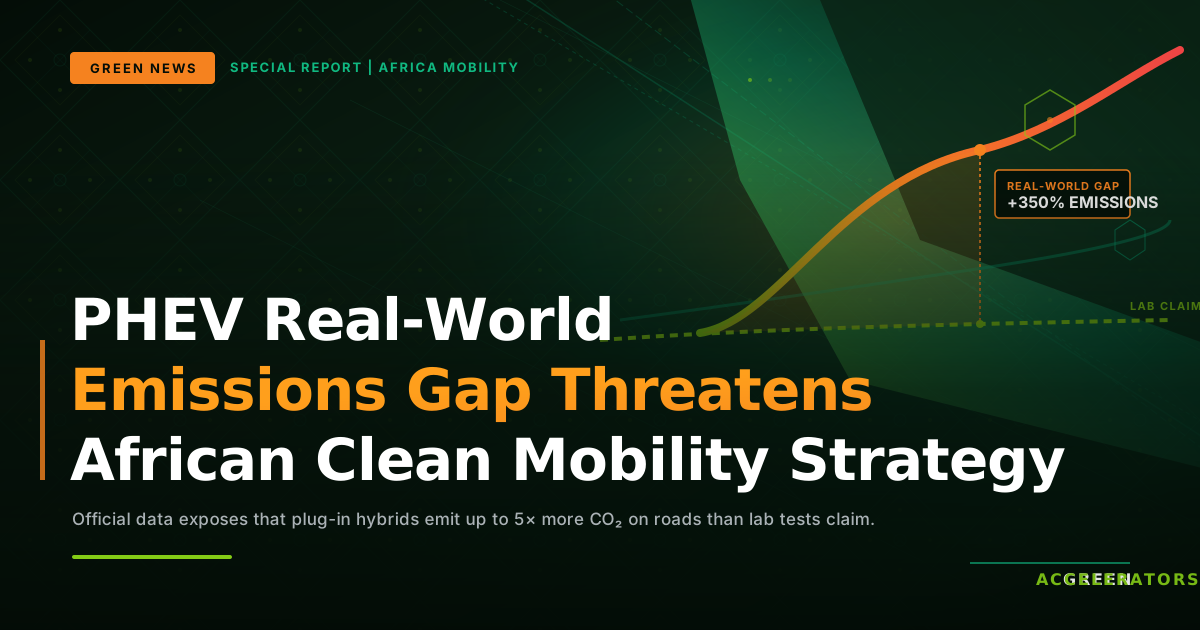
Flawed Testing Standards Mask True Fuel Consumption
Empirical analysis of 2024 vehicle performance data demonstrates a massive divergence between laboratory testing protocols and actual fuel consumption on the road. On average, real-world carbon emissions from modern plug-in hybrid electric vehicles exceed official test figures under the Worldwide Harmonised Light Vehicle Test Procedure by nearly six-fold.
Automotive manufacturers have increasingly shifted product strategies toward heavier, higher-powered hybrid models fitted with larger internal combustion engines and comparatively undersized electric drive systems. While these design choices allow manufacturers to achieve favorable ratings under current laboratory protocols, they fail during daily operation. In practice, vehicle owners deplete the limited electric range quickly, forcing the heavy combustion engine to propel a significantly heavier chassis.
Upcoming international regulatory adjustments scheduled for 2026 and 2027 aim to correct the utility factor metric, the formula used to estimate how often a vehicle operates in pure electric mode. However, the existing data confirms that current international standards have provided market cover for high-emitting vehicles, distorting global corporate emissions reporting and clean technology subsidies.
Regulatory Failures Drive the PHEV Real-World Emissions Gap
The widening gap between tested and actual vehicle performance is an institutional failure with direct financial and environmental consequences. European and international tax frameworks have long granted plug-in hybrids generous tax exemptions and import concessions based on laboratory ratings. Because these vehicles combine heavy battery packs with conventional internal combustion engines, their overall curb weight spikes, driving up fuel consumption exponentially once the battery disengages.
During my work coordinating transport transition pilots across Akwa Ibom State, our field assessments repeatedly showed that dual-powertrain vehicles operating without consistent charging infrastructure consume substantially more petrol per kilometer than standard, light-displacement engines. When international climate finance frameworks and domestic tax policies incentivize vehicles that perform six times worse than advertised, public capital is misallocated away from fully electric transport infrastructure and zero-emission micro-mobility.
The regulatory reliance on theoretical utility factors has delayed genuine technological innovation. Automakers have prioritized market demand for large, high-margin sport utility vehicles over actual carbon reduction, relying on small electric batteries to pass regulatory hurdles on paper while delivering high fossil-fuel reliance on the road.
What This Means for Nigeria and African Fleet Operators
For Nigeria and the broader African continent, this empirical breakdown carries serious economic and policy risks. Secondary vehicle markets across Lagos, Cotonou, and Mombasa continuously import used European and Asian light vehicles. As stricter Western regulations take effect in 2026 and force automakers to adjust their lineups, older and less efficient hybrid models will likely be offloaded into developing markets with weak emissions verification systems.
In Nigeria, where grid electricity constraints and diesel generator costs limit public charging availability, plug-in hybrids are almost never plugged into an electrical outlet. Drivers operate these vehicles almost exclusively on premium motor spirit. As a result, Nigerian fleet operators and private owners bear the cost of carrying redundant battery weight while burning expensive petrol at elevated rates.
The National Automotive Design and Development Council, alongside the Federal Ministry of Environment, must immediately update domestic green vehicle criteria. Tariff concessions and import incentives aimed at accelerating the energy transition should strictly target battery electric vehicles, low-displacement high-efficiency vehicles, and solar-powered two- and three-wheelers. Extending green tax breaks to plug-in hybrids under current testing standards drains national revenues while doing virtually nothing to reduce overall transport emissions.
What to Watch
- 30 Days: Statements from the Nigerian Customs Service and the Ministry of Finance regarding tax code definitions for imported hybrid powertrains versus pure zero-emission vehicles.
- 60 Days: Finalized regulatory documentation on the 2026 utility factor revisions to evaluate how global vehicle manufacturers plan to re-engineer battery capacity and electric motor power output.
- 90 Days: Procurement policy revisions among major West African corporate fleets and logistics companies as international carbon accounting frameworks begin penalizing unverified hybrid claims.
For practitioners in Nigeria and across Africa, this signals an urgent imperative to decouple national clean transport policy from flawed international laboratory assumptions and ground domestic incentives in real-world energy infrastructure reality.
Related Green Opportunities
Found this useful? Share it →
Written by Elkanah Oluyori
Director, Clement Isong Foundation · Uyo, Akwa Ibom State, Nigeria
Elkanah leads Clement Isong Foundation with 16+ years of experience in green economy development, climate justice, and civic technology in Akwa Ibom State and Nigeria. He is the founder of GreenAccelerators, Nigeria's first green economy opportunity portal.
Read all articles by Elkanah Oluyori →Get Weekly Green Opportunities in Your Inbox
Every Monday, we send the best verified green jobs, grants, fellowships and training opportunities — from Nigeria to the world, deadline still open — straight to your inbox. Free.
Put this into practice
Browse live green jobs, grants and training from Nigeria and around the world — or start a free Academy pathway today.
Related articles
Domestic Solar Energy Deployment Offers Economic Lifeline for Oil Nations
Academic research confirms that oil-producing countries strengthen their national treasuries and energy security by replacing internal fo…
South Africa Drives Demand Management for Renewable Energy Grid Integration
As grid expansion lags behind rapid commercial solar adoption, African power markets must shift from capital-intensive transmission build…
Africa Shifts From Carbon Market Potential to Delivery at CMAS 2026
The opening of the Carbon Markets Africa Summit (CMAS) 2026 in Kigali marks a structural pivot in how African carbon markets operate glob…