
Dangote Refinery Fuel Supply Expansion Reshapes Southern African Energy Security Pathways
Botswana's strategic move to negotiate fuel off-take deals via Namibian transit corridors reveals how intra-African downstream energy trade is restructuring continental logistics, creating complex trade-offs between immediate supply resilie
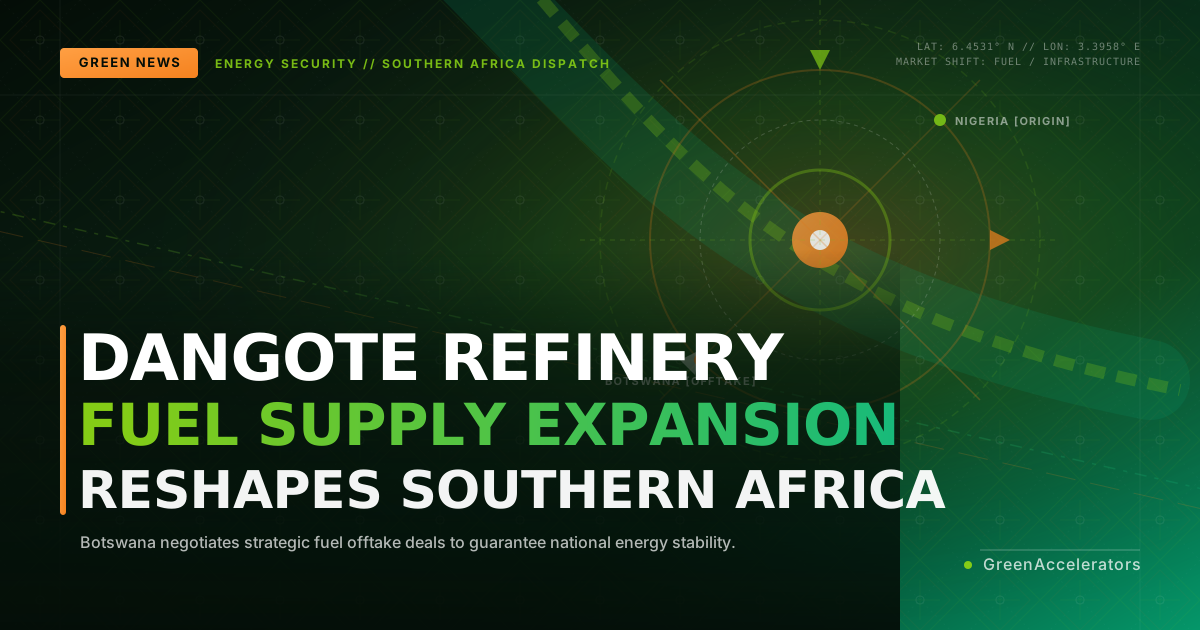
Strategic Realignment of Southern African Energy Imports
Governments across landlocked Southern Africa are fundamentally restructuring their national fuel procurement frameworks to hedge against global supply volatility and single-corridor transit risks. In Gaborone, senior energy officials have initiated bilateral trade discussions aimed at securing refined petroleum products from West African refining hubs, sovereign producers in the Gulf of Guinea, and Middle Eastern suppliers. Central to this structural shift is the potential integration of imported liquid fuels from Nigeria, where industrial operations in Lekki are scaling export capacity to service regional markets.
The mechanics of this proposed supply network rely on alternative maritime corridors that bypass traditional transit bottlenecks. Under the proposed logistics architecture, refined products would arrive at the deepwater terminal facilities of Walvis Bay in Namibia before moving inland via cross-border pipeline networks and dedicated overland routes into Botswana. This multi-port approach reflects a broader policy effort by non-coastal African states to reduce absolute operational reliance on single-country transit infrastructure.
For African downstream markets, the commercial entry of large-scale West African refining capacity into Southern African import baskets alters established trade flows. Historically reliant on long-haul imports from distant international refining hubs, regional markets are evaluating intra-continental supply routes to lower shipping transit times, minimize currency exposure risks, and stabilize domestic retail fuel pricing.
Aligning Dangote Refinery Fuel Supply Routes with Continental Transition Metrics
The expansion of intra-African petroleum trade corridors presents a dual challenge for climate practitioners and energy planners across the continent. On one hand, replacing long-distance intercontinental shipping with intra-continental supply chains shortens maritime trade routes, potentially lowering the gross transport emissions associated with imported finished fuels. On the other hand, heavy capital expenditure on new cross-border midstream infrastructure carries a structural risk of locking landlocked economies into decades of fossil fuel reliance precisely when capital should be flowing toward renewable infrastructure.
From my implementation experience leading green economy initiatives in Akwa Ibom State, relying entirely on long-distance liquid fuel distribution networks without building localized clean energy buffers exposes vulnerable communities to severe economic shocks whenever fuel transportation costs spike. During ground-level energy access assessments in coastal and agricultural districts, we consistently observed that imported fuel price volatility directly eroded local enterprise margins and stalled community-level development projects. Building heavy midstream pipeline corridors to transport fossil fuels across national borders must therefore be evaluated against the alternative of investing that same capital into localized solar microgrids and electrified transport systems.
If non-coastal nations construct new pipeline corridors to receive refined products, project sponsors and development finance institutions must insist on future-proofing these assets. Pipeline rights-of-way and storage infrastructure should be designed with dual-use specifications capable of integrating green hydrogen derivatives or bio-based liquid fuels as regional production scales up. Without strict green procurement mandates built into these supply contracts, expanding downstream fossil fuel networks risks dampening investments in regional clean energy alternatives.
What This Means for Nigeria and African Green Economy Actors
The expansion of West African refined product exports into Southern Africa creates direct operational and strategic implications for Nigerian green economy professionals, policy advisors, and project developers. As Nigerian industrial assets take on a dominant role in African energy logistics, domestic institutions face growing pressure to align refining standards and environmental compliance with international climate goals.
For Nigerian technical specialists, environmental auditors, and green engineering firms, this outward trade expansion offers an opportunity to export services across the continent. As cross-border pipeline projects and terminal expansions move from negotiation to technical execution, there will be growing demand for scope 3 emissions accounting, environmental impact assessments, and eco-efficiency monitoring along transit corridors like Walvis Bay. Nigerian practitioners who specialize in industrial decarbonization and transport emissions tracking can position themselves as key advisors to sovereign energy agencies across the SADC region.
At the policy level, African governments must guard against substituting external energy dependencies with internal lock-ins that bypass local green transitions. Donors, grant-making organizations, and multilateral climate funds targeting West and Southern Africa will likely adjust their country strategies. Funding will increasingly favor programs that integrate renewable energy into midstream logistics, such as solarizing pipeline pumping stations and deploying zero-emission transport fleets for off-grid fuel distribution.
What to Watch
- 30 Days: Formal signing of preliminary bilateral fuel off-take agreements and volume allocations between Gaborone and Nigerian export entities.
- 60 Days: Publication of technical feasibility studies and environmental disclosure reports for the proposed Walvis Bay cross-border pipeline transit corridor.
- 90 Days: High-level policy harmonization meetings among SADC and ECOWAS energy ministers regarding regional fuel specification standards and carbon accounting frameworks.
For practitioners in Nigeria and across Africa, this signals a critical moment where regional energy security negotiations must be actively integrated with low-carbon transport strategies to avoid permanent fossil fuel lock-in.
Related Green Opportunities
Found this useful? Share it →
Written by Elkanah Oluyori
Director, Clement Isong Foundation · Uyo, Akwa Ibom State, Nigeria
Elkanah leads Clement Isong Foundation with 16+ years of experience in green economy development, climate justice, and civic technology in Akwa Ibom State and Nigeria. He is the founder of GreenAccelerators, Nigeria's first green economy opportunity portal.
Read all articles by Elkanah Oluyori →Get Weekly Green Opportunities in Your Inbox
Every Monday, we send the best verified green jobs, grants, fellowships and training opportunities — from Nigeria to the world, deadline still open — straight to your inbox. Free.
Put this into practice
Browse live green jobs, grants and training from Nigeria and around the world — or start a free Academy pathway today.
Related articles
Why High-Yield Capital Markets Are Reclassifying Off-Grid Solar as Institutional Infrastructure
Energy sector capital allocators are reframing how financial institutions fund decentralized clean energy networks. Analysts and developm…
Why Nigeria Must Treat Off-Grid Solar as Public Infrastructure
African energy leaders are reaching a consensus: treating decentralized solar installations as short-term equipment purchases keeps milli…
Repsol Advances $1.5 Billion Onshore Wind Energy Investment Despite Federal Resistance
Repsol's progression on a 500-megawatt Illinois facility demonstrates how sub-national policy frameworks shield onshore wind energy inves…